The International Cricket Council (ICC) could come under pressure to review an incident involving West Indies fast bowler Jayden Seales after a controversial moment during the opening Test against Pakistan at the Brian Lara Cricket Academy in Trinidad sparked widespread debate on social media. The incident, which occurred during Pakistan’s fourth-innings chase, has raised questions over whether Seales deliberately allowed the ball to reach the boundary rope for tactical reasons, potentially bringing the ICC Code of Conduct into focus.
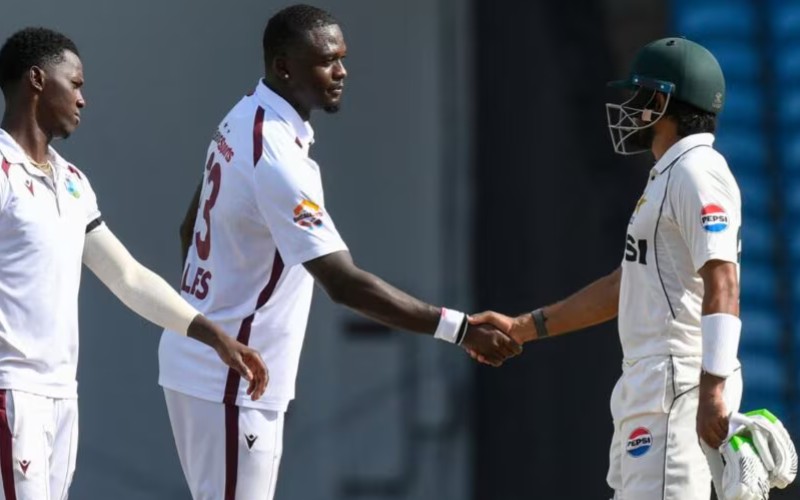
A video of the moment has gone viral, with many fans and former cricketers debating whether the West Indies pacer intentionally chose not to stop the ball in an effort to keep Pakistan captain Babar Azam off strike. While no official action has been announced, the footage has prompted discussions over whether the incident could warrant an ICC investigation.
Pakistan were chasing 211 for victory in the final innings but suffered a dramatic collapse despite Babar Azam standing firm at one end. The former Pakistan captain battled through difficult conditions and remained his side’s last recognized hope before West Indies wrapped up a convincing 90-run victory.
ALSO READ: India Selectors’ Long-Term Plans Clear As Mohammed Shami Faces Uncertain Test Future
The controversial moment unfolded late in the chase. On the final delivery of the 31st over, Shamar Joseph bowled to Babar Azam, whose shot trickled towards the fine-leg boundary. Jayden Seales sprinted across from the deep and appeared to have enough time to stop the slowly rolling ball.
However, instead of attempting a routine stop, Seales slowed down and watched as the ball crossed the boundary rope. The decision immediately caught the attention of commentators and fans, with many believing the move was a calculated tactical ploy to ensure Babar remained at the non-striker’s end for the first ball of the next over, allowing West Indies to target No. 11 batter Mohammad Abbas.
Jayden Seales not stopped the ball from reaching the boundary on the last delivery just to keep Babar Azam off strike and bring Abbas to face the next over. That’s called fear, Babar is standing like a wall. 🫡 pic.twitter.com/ExvAoOGeEV
— 𝐌𝐚𝐣𝐢𝐝 (@majidsays_) July 28, 2026
The incident has since been scrutinized under the ICC Code of Conduct. Article 2.11 states that any attempt to manipulate an international match for inappropriate strategic or tactical reasons may constitute an offence if proven. Depending on the circumstances, responsibility can also extend to the team’s captain if such actions are deemed intentional.
In addition, Article 2.20 covers conduct considered contrary to the spirit of cricket, regardless of whether the act was deliberate or accidental. While it remains unclear whether Seales intentionally allowed the boundary or simply misjudged the situation, the footage has fueled speculation and divided opinion across the cricketing world.
ALSO READ: Ravichandran Ashwin Selects Bold India XI For Sri Lanka Tests
If the ICC decides to examine the incident and determines that Seales breached the Code of Conduct, disciplinary action could follow. For a Level 1 offence, the penalties may include an official reprimand, one demerit point, and a fine of up to 50 percent of the player’s match fee. As of now, however, the ICC has not issued any official statement, and the incident remains the subject of debate rather than a confirmed disciplinary case.