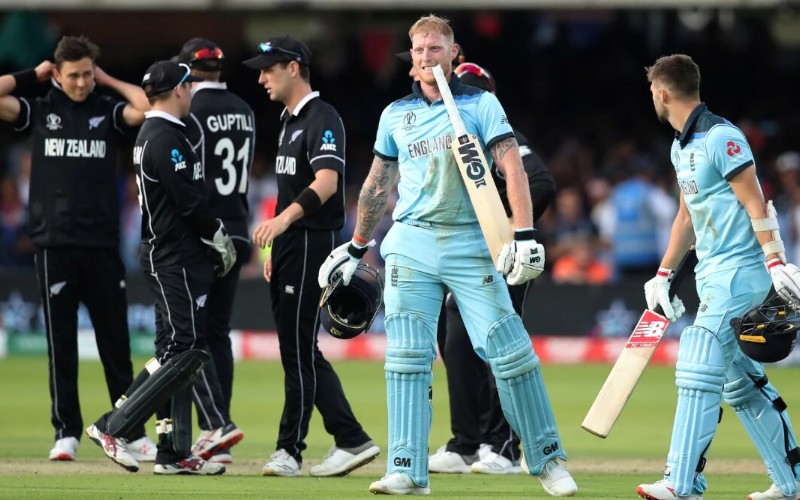
On this day in 2019, the ICC Men’s Cricket World Cup Final between England and New Zealand at Lord’s witnessed one of the most extraordinary finishes to a cricket match in the history of the game. What unfolded was a contest for the ages, packed with drama, tension, controversy, and unforgettable moments. The match not only ended in a tie but also required a Super Over, which ended in a tie, before England were declared winners based on the now-abolished boundary count rule — a finish that has since become part of cricketing folklore.
Batting first on a surprisingly dry Lord’s pitch, New Zealand scraped their way to 241/8 in 50 overs, thanks to gritty efforts from Henry Nicholls (55) and Tom Latham (47). England’s bowlers, particularly Chris Woakes (3/37) and Liam Plunkett (3/42), kept the Kiwis from running away with the game, exploiting the surface expertly with disciplined seam bowling.
However, New Zealand weren’t going to let England chase the target without a fight. Lockie Ferguson (3/50) and James Neesham (3/43) rattled the top order, reducing England to 86/4. But then arrived Ben Stokes (84*), calm yet fierce, and Jos Buttler (59), who built a crucial partnership to revive England’s hopes. When Buttler fell, England still needed 46 off 31 balls. The drama intensified.
ALSO READ: Nasser Hussain Backs KL Rahul and Rishabh Pant to Seal Lord’s Test for India
Stokes rode his luck — dropped by Trent Boult near the boundary — and battled on. With England needing nine off 3 in the final over, Stokes smashed a six, then a bizarre twist occurred: his attempted two resulted in an overthrow as the ball deflected off his bat and raced to the boundary. Umpire Kumar Dharmasena awarded six runs — an error, as law 19.8 stated that only five should have been given since the batsmen hadn’t crossed at the time of the throw. Dharmasena later admitted to the mistake.
A World Cup title decided by the finest of margins.#CWC19Final pic.twitter.com/iJUO7ElW8L
— ICC Cricket World Cup (@cricketworldcup) July 14, 2019
The equation came down to 3 runs off two balls. But two run-outs — Adil Rashid and Mark Wood — while attempting tight second runs meant the scores were level. For the first time in history, a World Cup final was tied after 50 overs. A Super Over was needed to decide the champion. Stokes and Buttler returned to score 15 off Trent Boult. New Zealand responded with Jimmy Neesham and Martin Guptill. Neesham’s six and some quick running brought them close, leaving two required off the final ball.
The moment the World Cup was won 🙌🏼#WeAreEngland | #CWC19 | #CWC19Final pic.twitter.com/Vt8onfi9hU
— ICC (@ICC) July 14, 2019
Jofra Archer, entrusted with the last over, delivered a near-perfect yorker. Guptill could only squeeze it to deep mid-wicket. The throw came in, and Buttler shattered the stumps before Guptill could return. New Zealand had tied the Super Over, but England won the World Cup by hitting more boundaries.
WATCH – Ben Duckett Sledges Shubman Gill Amid Tense Lord’s Test Battle
The result, though jubilant for England, was widely criticised, and the ICC soon scrapped the boundary count rule. Today, if a Super Over ends in a tie, another Super Over is played until a clear winner emerges. Still, nothing has matched the drama of that fateful day at Lord’s — a match that redefined how thrilling and heart-wrenching cricket can truly be.